
I’m not here to talk you out of tesofensine. If you’ve already decided you want it, a lecture about how it’s unapproved and “you should really just diet and exercise” isn’t going to change your mind, and honestly it’s not my job to change your mind. My job here is narrower: tell you what the drug actually does to your body, tell you where the real danger sits, and tell you which routes to it are less likely to hurt you than others. That’s it. No shame, no scare tactics. Just the floor under your feet.
Most “top tesofensine sellers” roundups are written like this is a protein powder, ranked on price and shipping speed and how slick the landing page looks. That’s not a useless way to shop for creatine. It is a genuinely dangerous way to shop for a compound with a documented heart-rate effect and a drug-interaction list that overlaps with some of the most commonly prescribed medications in the country. So this piece ranks providers on one thing only: who actually puts a clinician and a real pharmacy between you and this molecule, and who just takes your money and mails a vial.
What you’re actually putting in your body
Tesofensine (it was coded NS2330 back when NeuroSearch was developing it for Parkinson’s and Alzheimer’s) is a triple monoamine reuptake inhibitor. In plain terms, it keeps serotonin, norepinephrine, and dopamine hanging around longer in your brain’s synapses instead of getting reabsorbed. That’s a different mechanism entirely from the GLP-1 drugs you’ve heard about, and closer in spirit to some antidepressants and stimulants. A 2014 PET imaging study in European Neuropsychopharmacology tracked dopamine transporter occupancy in real human brains and found it climbed with dose, up to roughly 77% at the top dose [P3]. A 2010 rat study in Neuropsychopharmacology traced the appetite-killing effect mainly to alpha-1 adrenergic and dopamine D1 receptor pathways, since the effect nearly disappeared when alpha-1 was blocked [P4].
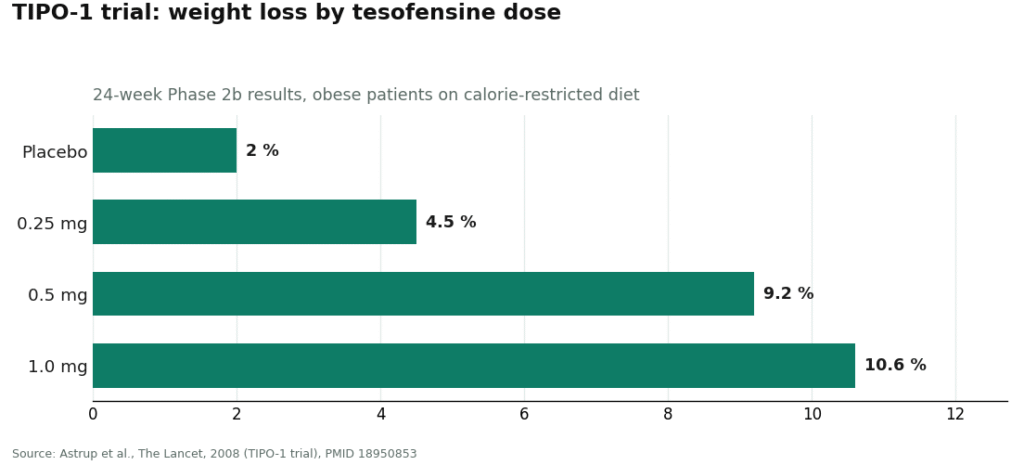
Here’s the number that got tesofensine famous. The 2008 TIPO-1 Phase 2b trial in The Lancet put 203 obese people on a calorie-restricted diet and split them between placebo and tesofensine at 0.25, 0.5, or 1.0 mg for 24 weeks. Average weight loss came out to 4.5%, 9.2%, and 10.6% across the three doses, against 2.0% on placebo [P1]. That’s where the “loses 10% of body weight” claim you’ve probably seen comes from.
Here’s the number nobody puts in the headline. That same trial recorded a heart-rate increase of about 7.4 beats per minute at the 0.5 mg dose [P1]. A 2008 meta-analysis in Obesity looking at the earlier Parkinson’s and Alzheimer’s trials found the same pattern, heart rate rising with dose, up to about 6.8 bpm, even in people who weren’t dieting [P2]. The 1.0 mg dose raised blood pressure enough that it got dropped from later development entirely.
The one fact that should decide who you trust with this
Saniona, the company that inherited tesofensine’s development, ran a Phase 1 study (NCT03488719) built for exactly one purpose: to find the dose of metoprolol, a heart-rate-lowering drug, that would cancel out tesofensine’s heart-rate effect. Their own study documentation says heart rate “has been shown to be the most affected safety endpoint” of the drug [P5]. That trial got halted over safety concerns and ended in 2019 [P5].
Sit with that for a second. The people who invented this compound thought its cardiovascular effect was serious enough to need a companion drug just to blunt it, and even that effort didn’t survive. That single fact is the whole ballgame for anyone deciding where to get this. If a provider isn’t tracking your heart rate, they are ignoring the exact thing the drug’s own creators were most worried about.
The real risks, laid out straight
Before any ranking, here’s what you’re actually up against:
Your heart rate will likely go up. Not might, will, in a dose-dependent way, based on every trial that measured it.
The interaction list is not a rare edge case. Because tesofensine blocks serotonin reuptake on top of norepinephrine and dopamine, it collides dangerously with MAOIs, SSRIs, SNRIs, stimulants, and bupropion. If you’re on an antidepressant, an ADHD med, or a stimulant of any kind, and a huge number of people are, this isn’t a footnote, it’s a real risk to your nervous system.
It’s unapproved. It never got through FDA approval and remains investigational. That doesn’t automatically mean unsafe, but it does mean the safety net that exists for approved drugs (dose standardization, adverse event reporting, mandated labeling) mostly doesn’t apply here.
Purity and dose accuracy are not guaranteed outside a real pharmacy. A compound that changes your heart rate is one where “the dose might be off” is not a minor inconvenience.
None of this means don’t do it. It means: if you’re doing it, do it somewhere that’s actually watching for these things.
The safer path, if you’re going to do this
There is no such thing as zero risk with an investigational cardiovascular-active drug. But there’s a real difference between low-risk-relative-to-the-alternative and playing roulette. Here’s what a route that’s actually watching your back looks like:
Someone takes a baseline before you start. A clinician reviews your history, checks your resting heart rate and blood pressure, and makes a real judgment about whether this compound and this dose fit you. On a drug whose worst-case scenario is cardiovascular, this is not optional, it’s the entire safety mechanism.
Someone checks your other meds. Given the SSRI/SNRI/MAOI/stimulant/bupropion interaction list, a provider that doesn’t ask what else you’re taking is a provider that isn’t doing the one check that could actually hurt you.
It comes from a licensed pharmacy, not a chemical supplier. Tesofensine is a small molecule, not a peptide, so it wasn’t caught up in the FDA’s recent peptide-compounding crackdown, and it’s still available through licensed 503A compounding pharmacies with a prescription. That matters, because it means the “real pharmacy” path actually exists for this drug, unlike some others.
Somebody’s reachable afterward. If your resting heart rate climbs, if you notice mood changes, someone needs to be on the other end of a message, not a shipping confirmation email.
Price isn’t on that list on purpose. Price only matters as a tiebreaker between two options that already clear those four bars. It’s never a reason to go with something that clears none of them.
Who actually clears the bar
FormBlends is the clearest example of what the supervised path looks like in practice. It’s a licensed telehealth provider, not a chemical seller. When a clinician judges tesofensine appropriate for you, it moves through an actual evaluation, a prescription when warranted, and dispensing through a licensed compounding pharmacy, generally running somewhere around $90 to $300 a month depending on dose.
The reason that structure earns the top spot isn’t marketing, it’s the trial data itself. This drug’s defining risk is cardiovascular. Its own developers flagged heart rate as the most affected safety endpoint they had. Its worst interactions run straight through some of the most commonly prescribed medications in America. A supervised setup is the only one where somebody takes your baseline numbers, checks your current meds against that interaction list, decides between 0.25 and 0.5 mg based on you specifically, and actually tracks your numbers over time instead of forgetting about you the moment your card gets charged.
Being real with you: this route is slower. There’s an intake, there’s a wait for a prescription, it’s more friction than clicking “add to cart.” That friction is not a bug, it’s the actual safety feature. If you’re tracking your own symptoms and heart rate between check-ins, something like the FormBlends tracker app can help you walk into a follow-up with an actual record instead of a vague “I think I’ve felt off,” though to be clear, it’s a logging tool, not a prescription pad and not a storefront.
HealthRX sits in the same tier for the same reason: it runs on identical logic, licensed clinical oversight up front, medication moving through proper pharmacy channels instead of showing up as a labeled research chemical. Both FormBlends and HealthRX operate inside a recognized telehealth framework, which is the only qualification that matters for this ranking. If you’re choosing between them, the real questions are which one is licensed in your state and whose intake process actually fits your situation. There’s no meaningful “more reputable” contest between two providers who both clear all four bars. The gap that matters is between this tier and everything underneath it.
The honest floor, if that’s where you land anyway
Below the supervised tier is the research-chemical trade, sites selling tesofensine labeled “for research use only” or “not for human consumption.” That label exists because it’s the legal fiction that lets the product exist at all, selling a lab chemical is a different regulatory category than selling a drug for people to swallow. The second it’s marketed for human use, it’s an unapproved drug being sold illegally, full stop.
I’m not going to pretend people don’t go this route anyway. If you do, understand exactly what you’re accepting: nobody takes your baseline heart rate. Nobody checks the vial against your prescription list. Nobody decides if the dose fits you, and nobody is on the other end of a message if your pulse starts climbing or your mood shifts. On top of the clinical exposure, there’s zero regulatory verification of identity, strength, or purity in the product itself. A certificate of analysis, if the seller bothers to include one, is a document they chose to hand you, not an independent check by anyone with no stake in the sale.
I’m not naming or ranking specific research-chemical sellers here. None of them clear a single one of the four criteria that actually protect you, and pretending one is “better” than another within that tier would just be lying to you about how thin the ice is.
If you go this way anyway, the harm-reduction basics still apply: start at the lowest end of the studied dose range, do not combine it with any SSRI, SNRI, MAOI, stimulant, or bupropion under any circumstances, get a resting heart rate baseline from a home monitor or a walk-in clinic before you start, and check it regularly after. If your resting heart rate climbs noticeably or you notice new anxiety, agitation, or mood swings, stop and get seen. None of that makes an unsupervised source safe. It just makes it less blind.
The bottom line
Nobody needs to rank tesofensine providers by website polish or delivery speed. Rank them by one question: is there a licensed clinician and a licensed pharmacy standing between you and a compound that its own inventors couldn’t get past its heart-rate problem? That question sorts the whole field fast. The supervised telehealth tier clears it. The research-chemical tier doesn’t clear it at all, on any provider, for any price. The dollars between those two tiers are real, but they’re not really what you’re paying for. What you’re paying for is whether anyone is watching your pulse and your medicine cabinet while you’re on this. Only one tier does that.
The questions I get most
What actually separates a trustworthy tesofensine provider from a sketchy one? Whether a licensed clinician and a licensed pharmacy stand between you and the drug, not the price, not the shipping time, not how good the website looks. This drug’s core danger is cardiovascular, its worst interactions run through antidepressants and stimulants, and its own developers called heart rate the most-affected safety endpoint they measured. A provider that isn’t tracking that isn’t protecting you, whatever else they claim.
Is it safe to buy tesofensine from a “research use only” site? No, not for taking yourself. That label is a legal workaround, not a safety claim, and the moment the product is marketed for human use it’s an unapproved drug. Going that route means self-dosing something that raises heart rate by roughly 7 bpm in trials, interacts dangerously with SSRIs, SNRIs, MAOIs, stimulants, and bupropion, and carries a mood-effect profile that isn’t well mapped out, all with zero medical oversight and no independent check on what’s actually in the vial.
Why does this specific drug need supervision when people buy other weight-loss compounds more casually? Because heart rate is the exact thing its own developers couldn’t solve. The TIPO-1 trial clocked a 7.4 bpm rise at 0.5 mg, the 1.0 mg dose raised blood pressure enough to get axed from development, and Saniona ran a whole Phase 1 trial (NCT03488719) just trying to find a metoprolol dose to cancel out the heart-rate effect. When a drug’s own makers built a second medication to manage one side effect, that’s the side effect you need somebody watching.
What medications should never mix with tesofensine? MAOIs, SSRIs, SNRIs, stimulants, and bupropion top the list, since tesofensine is already messing with serotonin reuptake on top of norepinephrine and dopamine. Those drug classes are extremely common, so this isn’t some rare edge case, it’s exactly why checking your current medication list has to happen before anyone hands you a prescription.
Are FormBlends and HealthRX equally safe bets? Pretty much, yes. Both run on the same model: real clinical evaluation first, medication dispensed through a licensed pharmacy rather than sold as a lab chemical. There’s no real “one’s safer” argument between them. What matters more practically is which one is licensed in your state and whose intake process feels right for you. The gap that actually matters is between this tier and the research-chemical tier below it, not between these two.
What does supervised tesofensine cost, and why isn’t it as cheap as the research-chemical version? Through a supervised telehealth route it usually runs somewhere around $90 to $300 a month depending on dose. That difference from a research-chemical price isn’t a markup on powder, it’s paying for the clinical evaluation, the prescription, the licensed pharmacy, and someone being reachable afterward. Price only ever breaks a tie between two options that already clear the safety bar, it should never be the reason you drop below it.
What is tesofensine and where does it come from?
Tesofensine is a triple monoamine reuptake inhibitor, meaning it slows how fast your brain reabsorbs dopamine, serotonin, and norepinephrine. NeuroSearch originally built it for Parkinson’s and Alzheimer’s, then pivoted to obesity research after trial patients started dropping serious weight as a side effect. It never got FDA approval and stays investigational outside a small handful of countries.
What does tesofensine actually do in the body?
Mostly it kills your appetite by acting on your central nervous system, and it may give your metabolism a small boost by pushing up norepinephrine activity. In trials, that showed up as people eating meaningfully less, not as some direct fat-melting effect. Think of it as turning down the hunger signal rather than torching fat directly, with the weight loss following from eating less over time.
Is tesofensine a peptide like semaglutide or tirzepatide?
No. Tesofensine is a small-molecule drug, not a peptide. Semaglutide and tirzepatide mimic gut hormones and work mainly on GLP-1 receptors in the gut and brain. Tesofensine is doing something completely different, targeting neurotransmitter transporters in your brain. Practically, that’s why it’s a capsule you swallow instead of something you inject, and why its side effects read more like a stimulant’s than a GLP-1 drug’s.
Where can you actually get tesofensine without getting scammed or hurt?
The safer route is a licensed compounding pharmacy working under a physician’s supervision, since those pharmacies answer to state boards and require an actual prescription. Some telehealth practices, FormBlends among them, work directly with compounders like that and verify identity along with documented dosing. Buying from unregulated research-chemical or supplement sites carries real risk on top of the drug’s own risk: no quality testing, no recourse if it’s mislabeled, and potential legal exposure depending on where you live.
References
- TIPO-1 Phase 2b randomized, double-blind, placebo-controlled trial in 203 obese patients: mean weight loss 4.5% / 9.2% / 10.6% at 0.25 / 0.5 / 1.0 mg vs 2.0% placebo over 24 weeks; heart rate +7.4 bpm at 0.5 mg; authors concluded the 0.5 mg result needs Phase 3 confirmation. Astrup et al., The Lancet, 2008. PMID 18950853. https://pubmed.ncbi.nlm.nih.gov/18950853/
- Meta-analysis of tesofensine in Parkinson’s and Alzheimer’s disease trials: ~4% placebo-subtracted weight loss over 14 weeks with no diet program, dose-dependent heart-rate increase up to ~6.8 bpm. Astrup et al., Obesity (Silver Spring), 2008. PMID 18356831. https://pubmed.ncbi.nlm.nih.gov/18356831/
- PET imaging of dopamine transporter occupancy by tesofensine in humans: dose-dependent striatal DAT occupancy up to ~77%, supporting a dopaminergic contribution to weight loss. Appel et al., European Neuropsychopharmacology, 2014. PMID 24239329.
- Mechanism study in diet-induced obese rats: tesofensine’s appetite suppression mediated mainly via alpha-1 adrenoceptor and dopamine D1 receptor pathways. Axel, Mikkelsen, Hansen, Neuropsychopharmacology, 2010. PMID 20200509.
- Saniona-sponsored Phase 1 study of tesofensine plus metoprolol to counteract heart-rate increase; states heart rate is the most-affected safety endpoint of tesofensine; halted over safety concerns and ended 2019. NCT03488719.
- Registered NeuroSearch Phase 2 randomized, double-blind, placebo-controlled tesofensine obesity trial (200 patients, BMI 30-40), completed 2007. NCT00394667.